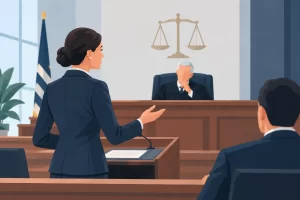
The moment cross-examination begins, the temperature in the courtroom changes. A witness who sounded confident in chief can suddenly look uncertain under precise, disciplined questioning. That is why cross examination tips matter – not as theatre, but as a serious part of testing evidence, exposing weakness and protecting the person whose case turns on what is being said.
In criminal, family and civil proceedings alike, cross-examination is not about asking more questions. It is about asking better ones. Done properly, it can narrow disputed facts, reveal inconsistency and challenge a version of events that initially appears persuasive. Done badly, it can strengthen the other side’s witness and hand over control.
What cross-examination is really for
Cross-examination has a clear purpose. It is not a chance to argue with the witness, give a speech, or show how much you know. Its job is to test reliability, credibility and accuracy. Sometimes that means proving a witness is mistaken rather than dishonest. Sometimes it means showing they have left out key details, exaggerated events or changed their story.
That distinction matters. Courts are alert to overreach. If you accuse every witness of lying, you can lose credibility yourself. Often, the more effective approach is tighter and more disciplined: establish what the witness said before, compare it to what they say now, and let the inconsistency speak for itself.
Cross examination tips that actually help in court
The best cross-examination usually looks simpler than it is. It rests on preparation, control and judgment.
1. Know the answer before you ask
A common mistake is asking an open question because it sounds forceful. In reality, that can be dangerous. If you do not know what answer is coming, you may give the witness room to repair damage, introduce new facts or explain away a weakness.
Good cross-examination is built on material already available – statements, records, CCTV, phone data, prior interviews, text messages, notes, and the witness’s own evidence-in-chief. Your questions should lead the witness through ground you have already mapped. Surprises are rarely your friend.
2. Keep questions short and leading
A leading question suggests the answer and limits the witness’s room to move. That is usually what you want in cross-examination. Short questions also help the court follow the point you are making.
Instead of asking, “Can you explain what happened when you arrived?”, a tighter approach may be, “You arrived after 10 pm, didn’t you?” Then: “It was dark at that time?” Then: “You were across the road when you first saw him?” One fact at a time. One proposition at a time.
Long questions create confusion and invite argument. Short ones create control.
3. Listen to the answer
This sounds obvious, but pressure changes habits. Some questioners become so fixed on their notes that they miss the answer in front of them. That can be costly. A witness may concede something important, qualify a previous claim or reveal uncertainty. If you are not listening, you may walk straight past it.
Cross-examination is structured, but it is not mechanical. You need a plan, and you also need the discipline to adapt when a useful answer appears.
4. Do not ask one question too many
This is one of the oldest rules for a reason. If you have made the point, stop. There is a temptation to press harder for a bigger concession, especially when momentum is with you. That is often where control is lost.
If a witness has already accepted that they did not have a clear view, there may be little value in pushing them into a defensive explanation. Bank the concession and move on. Courts remember clean points made well.
5. Use documents with purpose
Documents can be powerful in cross-examination, but only if used carefully. Putting a document to a witness should have a clear objective: proving inconsistency, fixing a time, showing omission, or challenging a detail they now claim to remember.
Do not wave papers around for effect. Take the witness to the precise part that matters. Confirm they made the statement, signed the record, sent the message or received the notice. Then isolate the contradiction. Precision carries weight. Vagueness does not.
6. Stay calm, even when the evidence is difficult
Aggression is not the same as strength. Some witnesses perform well under pressure and can win sympathy if they appear to be bullied. Others become evasive, and an angry tone only helps them avoid the substance.
A calm, firm style is usually more effective. It tells the court you are focused on facts, not theatrics. It also protects your client’s position. Judges and magistrates are used to seeing emotion in court. They are far more interested in whether the questioning is fair, relevant and properly directed.
7. Build around themes, not random points
Strong cross-examination has a theory behind it. You are not collecting disconnected moments. You are advancing a clear case theory, such as poor opportunity to observe, unreliable memory, bias, self-interest, recent invention, or inconsistency with objective evidence.
That theme should shape the order of your questions. If your point is that the witness could not reliably identify a person at night, then the lighting, distance, timing, stress, obstructions and duration of observation all fit together. The court should be able to see where the questioning is going.
8. Understand when not to cross-examine
This is one of the more overlooked cross examination tips. Not every witness needs to be challenged. Sometimes a witness has said nothing that harms your case. Sometimes their evidence is weak enough to leave alone. Sometimes cross-examining them only gives them a chance to repeat and improve their story.
The decision not to ask questions can be strategic, not passive. Restraint is part of good advocacy.
9. Match the style to the witness and the forum
A vulnerable witness in a family law matter is not approached in the same way as a police witness in a defended hearing. A busy local court mention is not the same as a contested trial. The rules of evidence, the judicial officer, the seriousness of the allegations and the witness’s role all affect how cross-examination should be conducted.
That is where experience matters. There is no one-size-fits-all technique. The right question in one courtroom can be the wrong one in another.
Where cross-examination often goes wrong
Many errors come from ego rather than strategy. The questioner wants the witness to admit they are lying, wants a dramatic moment, or wants to force a complete collapse. Real courts rarely work that way.
More often, cases are won by careful erosion. One inconsistency. One omission. One objective fact that does not fit. One reason the witness may not be as reliable as they first appeared. A court does not need fireworks to have reasonable doubt, or to prefer one version of events over another.
Another problem is poor preparation. If you have not mastered the brief, you will not control the witness. Dates will blur, prior statements will be missed, and opportunities to challenge key evidence will disappear. Cross-examination rewards preparation more than bravado.
Why these cross examination tips are only part of the picture
Even the best questioning cannot fix a case that has not been properly prepared. Cross-examination works as part of a broader strategy that includes identifying the real issues, obtaining relevant material, assessing the strengths and weaknesses of the evidence, and making sound decisions about what should and should not be contested.
That is particularly true in high-stakes matters, where one witness may affect bail, conviction, parenting arrangements, a licence outcome or the credibility of an entire claim. In those cases, the margin between a useful question and a harmful one can be narrow.
At El Baba Lawyers, that is how we view courtroom advocacy – not as performance, but as disciplined work done under pressure, with your rights and your future in sharp focus.
If you are preparing for court, the safest assumption is this: cross-examination is never just about speaking well on the day. It is about knowing the evidence, understanding the law, and asking only the questions that serve a clear purpose. When the stakes are high, that kind of discipline is often what protects the result that matters most.